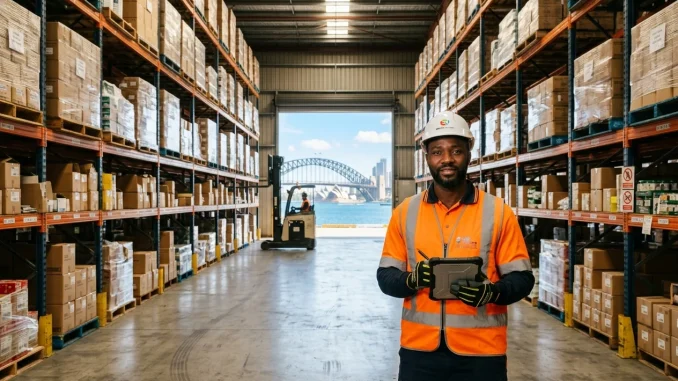
Australia’s logistics and warehousing industry is growing faster than it can hire — and right now, employers are actively looking beyond their borders to fill the gap. With over 250,000 warehouse and logistics workers needed across Australia’s supply chain sector by 2027, the demand for hardworking, reliable warehouse operatives has never been higher.
Warehouse operative jobs in Australia with visa sponsorship 2026 are a genuine, accessible opportunity for Nigerians and other African workers ready to build a better life abroad. You do not need a university degree. You do not need years of technical training. What you need is the right information, a strong application, and the willingness to take action.
This article gives you everything — realistic salaries, the top companies hiring right now, exactly what qualifications are required, and a proven step-by-step process for applying from Africa. Whether you are experienced in forklift operation, order picking, or general warehousing, there is a role in Australia waiting for you. Read on.
Why Australia is Hiring Warehouse Operatives in 2026
A Supply Chain Sector Stretched to Its Limits
Australia’s warehousing and logistics sector has experienced explosive growth driven by the e-commerce boom, population growth, and significant expansion in retail and manufacturing distribution networks. The country’s vast geography means warehousing is not concentrated in one area — demand exists in every major city and in regional hubs across Queensland, Victoria, New South Wales, and Western Australia.
Jobs and Skills Australia has flagged logistics and warehousing as a persistent area of workforce shortage, and major distribution companies are increasingly turning to international recruitment to keep operations running.
Key Demand Drivers in 2026
- E-commerce growth: Online shopping has permanently transformed Australia’s retail landscape. Amazon, Kmart, Woolworths, and dozens of other retailers are expanding their fulfilment centres at pace, creating thousands of new warehouse roles annually.
- Infrastructure investment: Billions of dollars in government-funded infrastructure projects are expanding Australia’s port, rail, and road freight networks — creating adjacent demand for warehousing capacity.
- Mining and resources sector: Western Australia and Queensland’s booming mining industries require large-scale warehousing for equipment, parts, and consumables — with premium wages to match.
- Post-pandemic reshoring: Australian businesses are moving supply chains closer to home, building new domestic warehousing capacity that requires staffing.
Government Immigration Support
While warehouse operative roles are not always on the highest-priority skills lists, many forklift operators, inventory controllers, logistics coordinators, and warehouse supervisors qualify for sponsorship through the Temporary Skill Shortage (TSS) Visa (subclass 482) and employer-nominated pathways. The Australian government actively encourages businesses to sponsor overseas workers where domestic labour is unavailable.
RELATED ARTICLES:
- Nurse Jobs in Australia with Visa Sponsorship 2026 – Salary AUD $85,000 – $180,000 | How to Apply
- Chef Jobs in Australia with Visa Sponsorship 2026 – Salary AUD $65,000 – $135,000 | How to Apply
- Electrician Jobs in Australia with Visa Sponsorship 2026 – Salary AUD $60,000 – $110,000 | How to Apply
Visa Sponsorship: What It Means for You
The Simple Explanation
Visa sponsorship means an Australian employer — a logistics company, distribution centre, or warehousing firm — formally agrees to hire you and officially sponsors your visa application through the Australian Department of Home Affairs. Instead of navigating Australia’s immigration system alone and funding the process yourself, the employer becomes your approved sponsor and handles the administrative and financial burden alongside you.
You do not need to already be in Australia. Applications are processed from your home country — Nigeria, Ghana, South Africa, or wherever you are based.
Who Qualifies?
To be considered for a sponsored warehouse operative role, you typically need:
- Relevant warehousing, logistics, or forklift operation experience
- A confirmed job offer from an Australian employer registered as an approved sponsor
- Ability to meet health and character requirements for the visa
- Basic English communication ability
- For higher-level roles — relevant certifications such as a forklift licence or inventory management qualification
What Does the Employer Cover?
When a logistics company commits to visa sponsorship, they often provide:
- Visa nomination and application fees — which can total AUD $3,000–$7,000 and are frequently absorbed by the employer
- A relocation package that may include international flights, temporary accommodation on arrival, and a settling-in allowance
- Training and induction covering Australian workplace safety standards (mandatory under Australian law)
- In regional and remote postings, subsidised or free accommodation is common
This employer-funded support significantly reduces the financial barrier to relocating — making Australia a realistic goal even for candidates without large personal savings.
Average Warehouse Operative Salary in Australia in 2026
Competitive Wages with Real Progression
Australia’s strong minimum wage laws and active unions mean even entry-level warehouse workers earn significantly more than the global average. The salary range for warehouse operatives sits between AUD $45,000 and $120,000 per year, depending on your role, experience, certifications, and location.
Salary Breakdown by Experience and Role Level
| Role / Experience Level | Annual Salary (AUD) |
|---|---|
| General Warehouse Hand / Picker-Packer (0–2 years) | $45,000 – $58,000 |
| Forklift Operator / Storeperson (2–5 years) | $59,000 – $78,000 |
| Senior Warehouse Operative / Team Leader (5–8 years) | $79,000 – $95,000 |
| Warehouse Supervisor / Logistics Coordinator (8+ years) | $96,000 – $120,000+ |
Workers on mining site warehouses in Western Australia or regional Queensland earn at the very top of these ranges — and overtime rates, which are legally protected, can add a further 25–50% to base earnings.
Benefits Typically Included
Beyond base salary, most sponsored warehouse roles come with:
- Superannuation — mandatory employer pension contribution of at least 11% of gross salary
- Paid annual leave — minimum 4 weeks per year by law
- Overtime and penalty rates — Saturday, Sunday, and public holiday work is paid at premium rates (typically 150%–200% of base hourly rate)
- Tool and equipment allowances — PPE, safety boots, and uniforms often provided
- Relocation package for international hires
- Regional postings often include free or subsidised accommodation
Top Employers Currently Sponsoring Warehouse Operatives in Australia
Where to Focus Your Applications
These are established Australian logistics and supply chain businesses with a history of international recruitment and active sponsorship of overseas workers:
1. Amazon Australia
Amazon’s rapidly expanding fulfilment centre network across Sydney, Melbourne, Brisbane, and Perth is one of the largest sources of warehousing employment in the country. As Amazon continues to grow its Australian operations, demand for warehouse associates at all levels remains high.
👉 [Apply at Amazon Australia]
2. Toll Group
One of Australia’s largest transport and logistics companies, operating across freight, warehousing, and supply chain management. Toll Group regularly engages in international recruitment for experienced warehousing and logistics personnel.
👉 [Apply at Toll Group]
3. Linfox Logistics
Australia’s largest privately owned logistics company, with operations spanning warehousing, transport, and supply chain services across Australia and the Asia-Pacific. Linfox sponsors skilled workers for key operational roles in their national distribution network.
👉 [Apply at Linfox Logistics]
4. Woolworths Group
Beyond retail, Woolworths operates a massive national distribution infrastructure including multiple large-scale automated distribution centres. The group regularly recruits for warehouse operative roles and offers stable employment conditions.
👉 [Apply at Woolworths Group]
5. DHL Supply Chain Australia
A global logistics leader with a substantial Australian operation across warehousing, fulfilment, and supply chain management. DHL actively recruits internationally for warehouse and logistics roles and is a well-known sponsor employer.
👉 [Apply at DHL Supply Chain Australia]
6. Coles Group
Australia’s second-largest supermarket chain operates a network of major distribution centres that require large numbers of warehouse staff. Coles’ logistics division is an active recruiter with strong employment conditions and structured career progression.
👉 [Apply at Coles Group]
7. Agility Logistics Australia
A global supply chain company with significant Australian warehousing operations across multiple industries including retail, mining, and resources. Agility is particularly active in regional and industrial areas where shortages are most acute.
👉 [Apply at Agility Logistics Australia]
Requirements & Qualifications
Minimum Education
- A secondary school certificate (equivalent to SSCE/WAEC in Nigeria) is typically the minimum educational requirement for entry-level warehouse roles
- No university degree is required for most operative positions
- For supervisory and logistics coordinator roles, a Certificate III or IV in Warehousing Operations or equivalent is advantageous — these can sometimes be completed online before arrival
Certifications and Licences
- A forklift licence (High Risk Work Licence — Forklift Truck) is one of the most valuable assets a warehouse operative can hold and significantly increases both employability and salary
- Your overseas forklift licence cannot be used in Australia — you will need to obtain an Australian High Risk Work Licence after arrival, which your employer will typically arrange and fund
- WHS (Workplace Health and Safety) awareness is expected of all warehouse workers in Australia — basic training is usually provided on induction
Work Experience
- Minimum 1–2 years of relevant warehouse, logistics, or manufacturing experience for entry-level roles
- Forklift operation, pick-and-pack, inventory management, and dispatch experience are all highly valued
- Evidence of productivity targets met, safety records maintained, or teams supervised strengthens your application substantially
Language Requirements
- Basic to intermediate English communication is required for all roles
- Formal English testing (IELTS/PTE) is generally not required for warehouse operative roles — however, for visa purposes, you must demonstrate adequate English
- For supervisory and coordinator roles, stronger written English is expected for reporting and compliance documentation
- If your previous schooling was conducted in English (as is the case for most Nigerian applicants), this usually satisfies the English requirement
Step-by-Step: How to Apply for Warehouse Operative Jobs in Australia with Visa Sponsorship
Follow this process from start to finish — each step is essential.
Step 1: Identify and Gather Your Documents
Before applying for anything, organise the following:
- Your academic certificates and transcripts
- Employment reference letters from previous warehouse or logistics employers
- Any forklift licence, safety certificates, or warehouse qualifications
- A valid international passport with at least 18 months remaining
Having all documents ready from the start dramatically speeds up every subsequent step.
Step 2: Build a Professional Australian-Style CV
Your CV must be:
- 2–3 pages maximum — concise and targeted
- Structured clearly: Profile Summary → Work Experience → Skills → Certifications → Education
- Achievement-focused rather than duty-focused (e.g. “Consistently exceeded daily pick rate targets by 20% across a 500-SKU operation”)
- Tailored specifically to each role and employer
- Free of photos (standard Australian CV convention)
Highlight any forklift operation experience, WMS (Warehouse Management System) knowledge, and safety record prominently.
Step 3: Research and Target the Right Employers
Use the job boards listed in the next section. Search specifically for terms like “warehouse operative visa sponsorship Australia 2026” or “storeperson 482 sponsored.” Prioritise companies that explicitly state willingness to sponsor or consider overseas applicants.
Set up daily email job alerts so you are among the first to apply when new sponsored roles appear.
Step 4: Submit Targeted Applications
Apply to multiple roles simultaneously — do not wait for responses before continuing. Customise your cover letter for each application, mentioning:
- Your specific warehousing skills and experience
- Your awareness of Australian workplace safety standards
- Your availability to relocate and your current visa status
Step 5: Prepare for Video Interviews
Australian employers typically conduct initial interviews via Zoom or Microsoft Teams. Research the company thoroughly before your interview. Be ready to discuss:
- Your experience with specific warehouse equipment and WMS systems
- How you handle high-volume, high-pressure operations
- Your approach to workplace safety and team collaboration
- Your timeline for relocation
Step 6: Receive Your Job Offer and Begin the Visa Process
Once a written job offer is confirmed, your employer will initiate the TSS 482 Visa nomination or alternative sponsored pathway. You will need to submit:
- Passport and identity documents
- Employment references and qualification certificates
- Police clearance certificate from Nigeria or your home country
- Medical examination results from an approved panel physician
The work permit visa processing timeline is typically 2–5 months from lodgement.
Step 7: Finalise Relocation and Begin Work
Once your visa is granted:
- Confirm your start date and relocation logistics with your employer
- Arrange flights — your relocation package may cover some or all of this cost
- Apply for your Tax File Number (TFN) and open an Australian bank account immediately upon arrival
- Complete your workplace induction and Australian High Risk Work Licence if required
- Begin work and start building your life in Australia
Best Job Boards to Find Sponsored Warehouse Operative Jobs in Australia
1. Seek.com.au
Australia’s largest and most active job platform. Use keyword filters like “warehouse visa sponsorship” or “storeperson overseas applicants.” New warehouse roles are listed every day across all states and territories.
2. LinkedIn Jobs
Ideal for connecting directly with logistics recruiters and supply chain HR teams. Follow major employers such as Toll Group, Linfox, and DHL to receive instant notifications when sponsored roles are posted.
3. Indeed Australia (au.indeed.com)
A powerful global aggregator pulling warehouse job listings from hundreds of Australian employer career pages. Set up customised email alerts for maximum coverage.
4. Glassdoor
Use Glassdoor to research working conditions, salary benchmarks, and employee reviews at your target employers before applying. Helps you prioritise the best companies and prepare more informed interview answers.
5. Jora (au.jora.com)
A fast-growing Australian job aggregator that pulls listings from sources not always found on Seek or Indeed. Particularly useful for finding regional and smaller employer warehouse roles that offer sponsorship due to local labour shortages.
Pro Tip: Register your profile with Adecco Australia, Programmed Staffing, and Labour Solutions Australia — leading Australian recruitment agencies that place large numbers of warehouse workers annually, including sponsored international candidates.
Common Mistakes to Avoid
Even strong, experienced candidates miss out on Australian warehouse jobs because of these avoidable errors:
- Applying without relevant experience documented: Australia’s immigration system requires employers to demonstrate they attempted to fill roles locally first. Having clearly documented experience makes you a stronger candidate and helps employers justify sponsoring you. Always quantify your warehouse experience with specific figures and timeframes.
- Ignoring regional opportunities: Sydney and Melbourne warehouse roles attract the most applications. Distribution centres in regional Queensland, South Australia, and Western Australia often offer higher wages, better sponsorship packages, and significantly less competition — yet many African applicants overlook them entirely.
- Sending the same generic CV to every employer: Warehouse recruiters process hundreds of applications. A generic, unformatted CV goes straight to the bottom of the pile. Tailor every application, use Australian CV conventions, and lead with your most relevant skills and certifications.
- Not mentioning forklift or WMS experience prominently: These are among the most sought-after skills in Australian warehousing. If you have forklift experience or have used any warehouse management software — SAP, Manhattan, Oracle WMS — make this the centrepiece of your CV, not a footnote.
- Dealing with unregistered migration agents: Only engage MARA-registered migration agents for visa assistance. Verify any agent’s registration at www.mara.gov.au. Never pay an upfront fee to an unverified person who claims to guarantee a job or visa — it is almost certainly a scam.
Frequently Asked Questions (FAQ)
❓ Can I bring my family to Australia on a warehouse operative work visa?
Yes. The TSS Visa (subclass 482) allows your spouse or de facto partner and dependent children to accompany you to Australia as secondary visa holders. Your spouse will have full work rights in Australia — they can work in any job, in any industry. Your children can attend Australian public schools. Many African warehouse workers have successfully relocated their entire families through this pathway.
❓ Do I need a forklift licence to get sponsored for a warehouse job in Australia?
Not for all roles, but it dramatically increases your chances. Forklift operators are consistently among the most in-demand warehouse workers in Australia, and employers are far more willing to sponsor a candidate who already holds forklift experience. You cannot use your Nigerian forklift licence in Australia directly — you will need to obtain an Australian High Risk Work Licence after arrival, which most employers will fund and arrange.
❓ What is the minimum experience needed for a sponsored warehouse job in Australia?
Most employers require at least 1–2 years of relevant warehouse experience for entry-level sponsored roles. However, candidates with specialised skills — forklift operation, dangerous goods handling, cold chain logistics, or inventory management software experience — may qualify with less general experience if their specific skills are in demand.
❓ Is there a path from a warehouse operative visa to Australian permanent residency?
Yes. The TSS 482 visa can lead to permanent residency through the Employer Nomination Scheme (ENS) subclass 186 after working with your sponsor for the required period (typically 2–3 years). Warehouse supervisors and logistics coordinators in regional areas may also qualify for the Regional Sponsored Migration Scheme. Permanent residency is followed by eligibility for Australian citizenship after four years.
❓ Are warehouse jobs in Australia suitable for candidates with no formal education beyond secondary school?
Absolutely. Warehouse operative roles in Australia are among the most accessible for candidates without university degrees. What matters most is your practical experience, your reliability, your safety awareness, and your work ethic. Many Nigerian workers with only secondary school qualifications have successfully secured sponsored warehouse jobs in Australia and built thriving careers in the logistics sector.
Conclusion & Call to Action
Australia’s warehousing and logistics sector is hiring — and it is hiring internationally. With salaries reaching AUD $120,000, legally protected overtime rates, employer-funded visa costs, and a clear pathway to permanent residency, warehouse operative jobs in Australia with visa sponsorship 2026 represent one of the most accessible international work opportunities available to African job seekers today.
You do not need a degree. You need experience, the right CV, and the courage to apply. Start preparing your documents today, set up your job alerts on Seek and LinkedIn, and target the employers listed in this guide.
The opportunity is real. The door is open. Your next move is to walk through it.
Bookmark this page and share it with someone looking for opportunities abroad
Leave a Reply