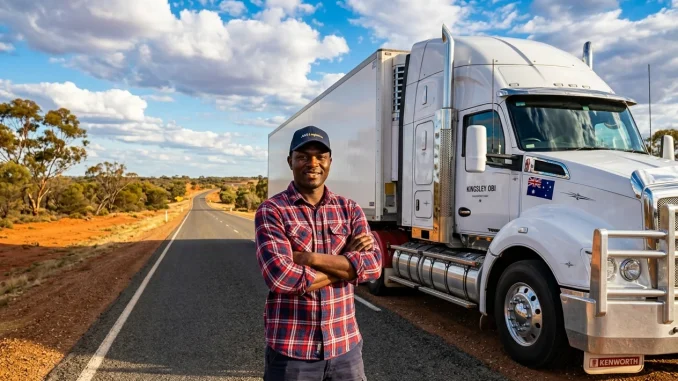
Australia moves on trucks — and right now, there are not enough drivers to keep it moving. The country is facing a shortfall of over 26,000 heavy vehicle drivers, with the Transport Workers’ Union warning that the gap is widening every year. For skilled, experienced drivers across Nigeria and Africa, this shortage is a direct invitation.
Truck driver jobs in Australia with visa sponsorship 2026 are open to internationally qualified candidates who hold the right licence, have verifiable driving experience, and are ready to relocate. Australia’s transport and logistics sector spans an enormous geography — from coastal cities to remote outback mining regions — and it needs reliable drivers at every level, from rigid truck operators to multi-combination road train drivers.
This guide covers everything you need to know: how much you will earn, which companies are actively sponsoring, what licences and documents you need, and a clear step-by-step process to apply from Africa. If you have been behind the wheel professionally, keep reading — your skills are in demand on the other side of the world.
RELATED ARTICLE:
- Warehouse Operative Jobs in Australia with Visa Sponsorship 2026 – Salary AUD $45,000 – $120,000 | How to Apply
- Nurse Jobs in Australia with Visa Sponsorship 2026 – Salary AUD $85,000 – $180,000 | How to Apply
- Chef Jobs in Australia with Visa Sponsorship 2026 – Salary AUD $65,000 – $135,000 | How to Apply
- Electrician Jobs in Australia with Visa Sponsorship 2026 – Salary AUD $60,000 – $110,000 | How to Apply
Why Australia is Hiring Truck Drivers in 2026
A Transport Sector Running on Empty
Australia’s freight industry is the backbone of its economy. With a landmass larger than the continental United States, road freight is not optional — it is essential. Yet the country’s heavy vehicle driver workforce is ageing rapidly, with the average age of an Australian truck driver now exceeding 50 years old. Retirements are outpacing domestic recruitment, creating structural vacancies that cannot be filled from within.
Jobs and Skills Australia has flagged Truck Drivers as a persistent shortage occupation, and several driver classifications appear on the occupation lists that support employer-sponsored visa pathways. This gives Australian transport companies a legitimate, government-backed mechanism to recruit internationally.
Key Demand Drivers in 2026
- E-commerce expansion: The surge in online retail has dramatically increased last-mile and long-haul freight volumes. Major distribution networks are expanding rapidly and need drivers at every tier.
- Mining and resources boom: Western Australia and Queensland’s resource sector relies heavily on road freight for equipment, fuel, and supplies. Mining logistics roles offer the highest driver salaries in the country.
- Agricultural freight: Australia’s vast agricultural sector requires seasonal and year-round transport of produce, livestock, and supplies across long distances — roles that are chronically understaffed.
- Infrastructure construction: Billions of dollars in national road, rail, and building projects generate enormous demand for construction material haulage and site logistics drivers.
- Ageing workforce: With the majority of current drivers approaching retirement age, the replacement pipeline is severely insufficient.
Government Immigration Support
The Australian government has structured its visa system to allow employers facing genuine shortages to sponsor overseas workers. Heavy vehicle drivers can qualify under the Temporary Skill Shortage (TSS) Visa (subclass 482), and experienced drivers in roles matching the ANZSCO classification for Truck Driver (733111) and related codes are eligible for international recruitment through approved employer sponsors.
[See also: Top 10 Transport and Logistics Jobs in Australia Open to African Workers in 2026]
Visa Sponsorship: What It Means for You
Breaking It Down Simply
Visa sponsorship means an Australian transport company formally agrees to hire you and officially sponsors your application for a work visa through Australia’s Department of Home Affairs. Rather than managing the entire immigration process yourself, the employer becomes your approved sponsor — guiding you through the paperwork, covering key costs, and legally vouching for your employment in Australia.
You do not need to be in Australia to be sponsored. The entire process — from job application to visa approval — can be handled from Nigeria or your home country.
Who Qualifies?
To be eligible for a sponsored truck driver role, you generally need:
- A valid heavy vehicle driving licence (convertible to an Australian equivalent)
- Relevant professional truck driving experience (typically 2+ years)
- A confirmed job offer from an Australian-registered approved sponsor employer
- Clean driving record with no major traffic offences
- Ability to pass health, character, and medical fitness assessments required for the visa
What Does the Employer Cover?
When a transport company commits to visa sponsorship, they commonly provide:
- Visa nomination and application fees — which can total AUD $3,000–$7,000, often fully absorbed by the employer
- A relocation package including international flights, temporary accommodation on arrival, and a settling-in allowance
- Licence conversion support — helping you obtain your Australian heavy vehicle licence after arrival, including funding the required tests
- In regional and remote postings, free or heavily subsidised accommodation is frequently included as part of the compensation package
This support removes the biggest financial barriers to relocating and makes Australia a realistic destination even for candidates without large personal savings.
[See also: How to Convert Your Nigerian Driving Licence for Use in Australia — Full Guide]
Average Truck Driver Salary in Australia in 2026
Among the Highest Truck Driver Wages in the World
Australia’s strong minimum wage framework, active transport unions, and legally protected penalty rates make it one of the most rewarding countries in the world for professional drivers. The salary range for sponsored truck drivers sits between AUD $60,000 and $150,000 per year, depending on vehicle type, route, experience, and sector.
Salary Breakdown by Role and Experience Level
| Role / Experience Level | Annual Salary (AUD) |
|---|---|
| Rigid Truck Driver (0–2 years in Australia) | $60,000 – $72,000 |
| Semi-Trailer Driver (2–5 years experience) | $73,000 – $92,000 |
| B-Double / Heavy Combination Driver (5–8 years) | $93,000 – $115,000 |
| Road Train / Multi-Combination Driver (8+ years) | $116,000 – $150,000+ |
Drivers working in Western Australia’s mining sector or on long-haul outback routes consistently earn above AUD $120,000 — with overtime and allowances pushing total packages significantly higher.
Benefits Typically Included
Beyond base salary, sponsored driving roles generally include:
- Superannuation — mandatory employer pension contribution of at least 11% on top of base salary
- Paid annual leave — minimum 4 weeks per year protected by law
- Overtime and penalty rates — night shifts, weekends, and public holidays attract premium pay (150%–200% of base rate)
- Per diem allowances for overnight and long-haul routes
- Relocation package for international recruits
- Accommodation and meal allowances for remote and regional postings
- Vehicle, fuel, and maintenance costs covered entirely by the employer
Top Employers Currently Sponsoring Truck Drivers in Australia
Where to Direct Your Applications
These are established Australian transport and logistics companies with a track record of international recruitment and active sponsorship of overseas driving talent:
1. Toll Group
One of Australia’s largest integrated transport and logistics companies, operating across road freight, warehousing, and supply chain services. Toll Group has a well-documented history of sponsoring experienced heavy vehicle drivers for long-haul and metropolitan routes nationwide.
👉 [Apply at Toll Group]
2. Linfox Logistics
Australia’s largest privately owned transport and logistics company, with a fleet spanning thousands of vehicles across Australia and the Asia-Pacific. Linfox sponsors skilled drivers for both regional distribution and long-haul freight operations.
👉 [Apply at Linfox Logistics]
3. TNT Australia (FedEx)
A major express freight and logistics operator running a vast road transport network across every Australian state and territory. TNT/FedEx actively recruits for both rigid and semi-trailer driving roles and is an approved sponsor employer.
👉 [Apply at TNT Australia]
4. K&S Freighters
A specialist bulk and general freight company with operations focused on long-haul interstate and regional routes. K&S is known for sponsoring experienced heavy combination and road train drivers, particularly for routes into Western Australia and the Northern Territory.
👉 [Apply at K&S Freighters]
5. Coles Supermarkets Transport Division
Coles operates its own national trucking fleet for supermarket distribution. The company is an approved sponsor and regularly recruits experienced drivers for both metropolitan delivery and long-haul interstate distribution routes.
👉 [Apply at Coles Transport]
6. Scott’s Refrigerated Logistics
Specialises in temperature-controlled freight — one of the fastest-growing niches in Australian trucking. Drivers with refrigerated transport experience are particularly sought after, and Scott’s has a history of sponsoring international talent for specialist routes.
👉 [Apply at Scott’s Refrigerated Logistics]
7. BHP and Rio Tinto (Mining Haulage Contractors)
While not transport companies themselves, BHP and Rio Tinto’s mining operations in Western Australia engage contract trucking firms that sponsor heavy vehicle drivers for on-site and off-road haulage roles. These are among the highest-paid driving positions available in Australia.
👉 [Apply via Mining Haulage Contractors at BHP / Rio Tinto]
Requirements & Qualifications
Driving Licence Requirements
- A valid heavy vehicle driving licence from your home country is the starting point — Nigerian, Ghanaian, South African, and other African licences are accepted as proof of driving competence
- Your overseas licence cannot be used to drive commercially in Australia — you must obtain an Australian Heavy Rigid (HR), Heavy Combination (HC), or Multi-Combination (MC) licence after arrival
- Most sponsoring employers arrange and fund the Australian licence conversion process, which typically involves a practical driving assessment and knowledge test
- Drivers with prior experience in B-double, road train, or articulated vehicles should document this clearly — it qualifies you for higher licence classes and significantly higher salaries
Minimum Experience
- At least 2–3 years of verifiable, professional heavy vehicle driving experience
- Experience should be documented with employer references, logbook records, or statutory declarations
- Specialist experience — refrigerated transport, dangerous goods (ADG licence), mining site haulage, or livestock transport — substantially increases your competitiveness and salary prospects
Medical and Fitness Requirements
- All heavy vehicle drivers in Australia must meet medical fitness standards under the Australian Fitness to Drive guidelines
- A medical examination confirming vision, cardiovascular health, and absence of conditions affecting driving fitness is required for both visa and licence purposes
- Your employer will guide you to an approved medical examiner — this is typically arranged after your job offer is confirmed
Language Requirements
- Basic to intermediate English is required for safety compliance, communication with dispatch, and understanding road signs and regulations
- Formal English testing (IELTS/PTE) is generally not required for truck driving roles specifically, but English proficiency must be demonstrated for visa purposes
- Most Nigerian applicants who completed secondary education in English satisfy this requirement without formal testing
Additional Certifications
- Dangerous Goods (ADG) licence — required for transporting hazardous materials; highly valued and attracts a salary premium
- Load restraint and fatigue management training — mandatory in Australia and typically provided by your employer on induction
- A clean driving record with no major traffic offences or licence suspensions is essential — Australian employers and the visa process both require a verified driving history
Step-by-Step: How to Apply for Truck Driver Jobs in Australia with Visa Sponsorship
Follow this exact process — do not skip any step.
Step 1: Gather and Organise Your Documents
Before applying for any role, collect and certify:
- Your current driving licence (international and local)
- Logbooks or employment references documenting your heavy vehicle driving history
- Your secondary school certificate and any transport or logistics qualifications
- A valid international passport with at least 18 months remaining
- Police clearance certificate from Nigeria or your home country
Having these ready from the start prevents delays once employers begin requesting documentation.
Step 2: Build a Professional Australian-Style CV
Your CV must be:
- 2–3 pages — targeted and concise
- Structured as: Professional Summary → Driving Experience → Vehicle Types Operated → Licences & Certifications → Work History → Education
- Specific about vehicle types (rigid, semi-trailer, B-double, road train), payload weights, routes operated, and annual kilometres driven
- Achievement-oriented (e.g. “Maintained a zero-incident safety record across 280,000 km of long-haul freight operations over four years”)
- Free of photos — standard Australian CV convention
Your vehicle experience and safety record are your biggest selling points. Lead with them.
Step 3: Research and Identify Target Employers
Use the job boards in the next section to search for “truck driver visa sponsorship Australia 2026” or “heavy vehicle driver 482 sponsored.” Identify companies explicitly open to overseas applicants. Set up daily job alerts on Seek and Indeed so you apply the moment new sponsored roles are posted.
Step 4: Submit Tailored Applications
Apply to multiple employers simultaneously. Write a targeted cover letter for each application that specifically mentions:
- The vehicle classes you are qualified and experienced to operate
- Your safety record and any specialist certifications
- Your availability to relocate and your current documentation status
- Your awareness of Australian traffic regulations and commitment to compliance
Step 5: Prepare for Your Video Interview
Australian transport companies conduct initial interviews via Zoom or Microsoft Teams. Prepare to discuss:
- Your specific driving experience — routes, distances, vehicle types, payloads
- How you manage driver fatigue and comply with hours-of-service regulations
- Your approach to vehicle inspections, pre-start checks, and incident reporting
- Your personal timeline for relocation and readiness to begin licence conversion
Step 6: Secure Your Job Offer and Initiate the Visa Process
Once a written job offer is received, your employer will begin the TSS Visa (subclass 482) nomination process or applicable skilled worker visa pathway. You will need to provide:
- All documents gathered in Step 1
- Medical examination results from an approved panel physician
- Driving history verification from your home country licensing authority
The work permit processing timeline is typically 2–5 months from the date of lodgement. Respond to any requests from the Department of Home Affairs promptly to avoid unnecessary delays.
Step 7: Complete Your Licence Conversion and Begin Driving in Australia
Once your visa is approved:
- Confirm start date and relocation package details with your employer
- Book flights — your employer may cover this cost entirely
- Upon arrival, apply for your Australian Driver Licence at the local transport authority (your employer will guide and fund this process)
- Complete your workplace induction, fatigue management training, and any load-restraint certification
- Register for your Tax File Number (TFN) and open an Australian bank account
- Start work and begin your journey to permanent residency
Best Job Boards to Find Sponsored Truck Driver Jobs in Australia
1. Seek.com.au
Australia’s largest and most comprehensive job platform. Search “truck driver visa sponsorship” or “heavy vehicle driver overseas.” New transport roles appear daily — set up alerts to stay ahead of other applicants.
2. LinkedIn Jobs
Essential for connecting directly with transport company HR managers and fleet recruiters. Search “truck driver 482 sponsorship Australia 2026” and follow major logistics employers to see vacancies as they are posted.
3. Indeed Australia (au.indeed.com)
A global aggregator pulling listings from transport company career pages and staffing agencies across Australia. Use detailed keyword searches and set up email alerts for maximum reach.
4. Glassdoor
Use Glassdoor before applying to any company — research salary data, management reviews, and employee experiences. This helps you identify which sponsoring employers have the best working conditions and driver retention rates.
5. Transport Workers’ Union Job Board & Industry Sites (e.g. TruckSales.com.au careers section)
Industry-specific Australian platforms where transport companies post vacancies directly. Particularly useful for finding regional, long-haul, and mining logistics roles that do not appear on mainstream job boards.
Pro Tip: Register your profile with Programmed Transport, Adecco Transport & Logistics, and Labour Solutions Australia — specialist Australian staffing agencies that place heavy vehicle drivers in both metro and regional roles, including sponsored international candidates.
Common Mistakes to Avoid
Even experienced, qualified drivers miss out because of these preventable errors:
- Applying without verifiable driving records: Australian employers and the visa system require documented evidence of your driving history. Vague claims of “10 years driving experience” without references, logbooks, or employer letters will get your application discarded. Obtain formal reference letters from every previous employer before applying.
- Overlooking regional and mining sector opportunities: The highest-paying truck driving roles in Australia are not in Sydney or Melbourne — they are in the Pilbara, the Kimberley, outback Queensland, and the Northern Territory. These roles offer premium salaries, free accommodation, and faster visa processing, yet receive far fewer applications from international candidates.
- Not researching Australian road rules and regulations: Demonstrating awareness of Australian traffic law, fatigue management regulations, and chain of responsibility laws in your interview signals professionalism and dramatically improves your chances. Spend time studying the Heavy Vehicle National Law (HVNL) before your interview.
- Expecting to use your overseas licence directly: Your Nigerian or African driving licence cannot be used commercially in Australia from day one. Understanding and clearly communicating that you are prepared to complete the Australian licence conversion process quickly — and that your employer will support this — removes a common employer concern.
- Engaging unregistered migration agents: Only use MARA-registered migration agents for visa assistance. Verify any agent’s registration number at www.mara.gov.au. Never pay a large upfront fee to anyone promising to “secure” you an Australian truck driving job — legitimate processes do not work that way.
Frequently Asked Questions (FAQ)
❓ Can I bring my family to Australia on a truck driver work visa?
Yes. The TSS Visa (subclass 482) allows your spouse or de facto partner and dependent children to join you in Australia as secondary visa holders. Your spouse will have unrestricted work rights — they can work full-time in any industry. Your children can attend Australian public schools. Thousands of African transport workers have successfully relocated their families to Australia through this pathway.
❓ Can I use my Nigerian or African driving licence in Australia?
Not for commercial truck driving. Your overseas licence may allow you to drive a private vehicle in Australia temporarily, but to drive commercially, you must obtain an Australian Heavy Rigid (HR), Heavy Combination (HC), or Multi-Combination (MC) licence. Most sponsoring employers arrange and fund the practical assessment and knowledge test required to convert your experience into an Australian licence — typically completed within your first few weeks of arrival.
❓ What is the difference between an HR, HC, and MC truck licence in Australia?
- HR (Heavy Rigid): For trucks with more than 2 axles, including large rigid trucks and buses
- HC (Heavy Combination): For semi-trailers and articulated vehicles
- MC (Multi-Combination): For B-doubles, road trains, and the largest heavy vehicle combinations
Higher licence classes unlock higher-paying routes and employer opportunities. Your overseas experience in articulated or combination vehicles will directly inform which class you test for.
❓ Do truck drivers in Australia need a dangerous goods licence?
Not for all roles, but it is highly valuable. A Dangerous Goods (ADG) Driver Licence is required for transporting hazardous chemicals, fuel, gases, or other regulated materials. Drivers who hold this certification earn significantly more and are in particularly high demand in the mining and resources sector. Your employer can arrange and fund this training after arrival.
❓ Is there a path from a sponsored truck driver visa to Australian permanent residency?
Yes — and it is a well-trodden path. After working with your sponsor employer for 2–3 years on the TSS 482 visa, you become eligible to apply for permanent residency through the Employer Nomination Scheme (ENS) subclass 186. Drivers working in regional and remote Australia may qualify for permanent residency even faster through the Regional Sponsored Migration Scheme. Australian citizenship follows after four years of permanent residency.
Conclusion & Call to Action
Australia needs truck drivers — urgently, consistently, and in every corner of its vast territory. With salaries reaching AUD $150,000, legally protected overtime rates, employer-funded visa and licence conversion costs, and a proven pathway to permanent residency, truck driver jobs in Australia with visa sponsorship 2026 are one of the most powerful opportunities available to skilled African transport professionals right now.
You do not need a degree. You need your licence, your experience, and the discipline to apply correctly. Start gathering your driving records today, build your Australian-style CV, and begin targeting the employers and job boards in this guide. Every week you delay is another week someone else gets your seat.
Bookmark this page and share it with someone looking for opportunities abroad.
Leave a Reply