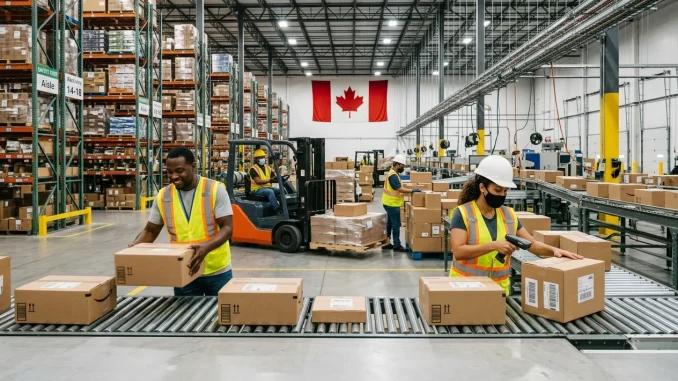
Canada’s Warehouses Are Empty — And They Need You to Fill Them
What if we told you that one of the world’s most immigrant-friendly countries is actively recruiting warehouse workers from Africa, Asia, and beyond — and is willing to sponsor your visa, cover your relocation, and offer you a path to permanent residency in the process?
That is not a promise from a recruitment scammer. That is the documented reality of Canada’s labour market in 2026.
Canada’s e-commerce explosion, supply chain restructuring, and an ageing domestic workforce have created a critical shortage of warehouse operatives from coast to coast. Employers cannot fill these roles fast enough from within Canada alone — which is precisely why warehouse operative jobs in Canada with visa sponsorship 2026 are among the most accessible and genuinely achievable opportunities for Nigerians, Ghanaians, Kenyans, South Africans, and other globally mobile workers right now.
This article gives you everything: the context, the salaries, the employers, the requirements, and a precise step-by-step application process. Read every section — it could change your life.
Why Canada Is Hiring Warehouse Operatives in 2026
A Labour Crisis That Cannot Be Solved Domestically
Canada is in the middle of a structural labour shortage that economists describe as one of the most severe in the country’s post-war history. The Retail Council of Canada, the Canadian Supply Chain Sector Council, and Statistics Canada have all published data confirming that logistics, warehousing, and fulfillment roles are among the hardest positions for Canadian employers to fill domestically.
The core problem is demographic. Canada’s baby boomer generation — those born between 1946 and 1964 — is retiring at a rate of approximately 1,000 people per day. As these experienced workers leave the labour force, there are simply not enough young Canadians entering trades and logistics roles to replace them. The Canadian Federation of Independent Business (CFIB) reported in 2025 that labour shortages cost Canadian businesses an estimated $38 billion annually in lost output.
Warehousing and logistics are at the epicentre of this crisis.
The E-Commerce and Supply Chain Revolution
Canada’s e-commerce sector has grown by over 200% since 2019, largely accelerated by the COVID-19 pandemic and the sustained shift in consumer buying habits. Companies like Amazon, Walmart Canada, Loblaw, Canadian Tire, and Purolator have invested billions in new fulfillment centres, regional distribution hubs, and last-mile delivery infrastructure across Ontario, Alberta, British Columbia, and Quebec.
Every new fulfillment centre requires hundreds of warehouse operatives, order pickers, forklift operators, inventory controllers, and logistics coordinators. These roles cannot be automated entirely — human dexterity, problem-solving, and physical labour remain irreplaceable in warehouse environments.
Key demand drivers in 2026 include:
- Amazon’s Canadian expansion: New fulfillment centres opened or under construction in Mississauga, Calgary, and Vancouver require thousands of warehouse staff.
- Grocery sector logistics: Loblaw and Metro Inc. are expanding their cold-chain distribution networks, requiring operatives with food handling experience.
- Automotive parts distribution: The resurgence of Canadian auto manufacturing in Windsor and Oshawa has created significant demand for parts logistics and warehouse operatives.
- Cannabis industry warehousing: Canada’s regulated cannabis sector requires licensed warehouse and inventory specialists.
- Third-party logistics (3PL) boom: Companies like Kuehne+Nagel, DHL Supply Chain, and XTL Transport are expanding their Canadian operations rapidly.
Government Immigration Support: Ottawa Is On Your Side
The Canadian federal government has formally acknowledged the labour shortage in logistics and warehousing. Through Immigration, Refugees and Citizenship Canada (IRCC), the government has expanded and streamlined several immigration pathways that make it easier for international workers to enter warehouse roles legally and efficiently.
Warehouse operatives typically fall under NOC (National Occupational Classification) codes 14400 (Shippers and Receivers) and 75101 (Material Handlers) — both of which are eligible occupations under multiple immigration programs. The government’s Temporary Foreign Worker Program (TFWP) and International Mobility Program (IMP) both accommodate these roles, and several Provincial Nominee Programs (PNPs) have created dedicated streams for logistics and supply chain workers.
The federal government’s Immigration Levels Plan 2024–2026 targets over 485,000 new permanent residents per year — and skilled and semi-skilled workers in logistics play a significant part in meeting that target.
RELATED ART|ILES:
- Welder Jobs in Canada with Visa Sponsorship 2026 – Salary CAD $45,000 – $85,000 | How to Apply
- Affordable Apartments in Manchester for New Immigrants: The Complete 2026 Guide
Visa Sponsorship: What It Means for You
The Simple Explanation
Visa sponsorship is when a Canadian employer formally agrees to hire you as an international worker and takes legal responsibility for supporting your immigration paperwork. In practical terms, the employer says to the Canadian government: “We have a genuine vacancy. We searched for a Canadian worker and could not find one. We want to hire this person from abroad.”
This declaration is formalised through a process called a Labour Market Impact Assessment (LMIA) — a government evaluation conducted by Employment and Social Development Canada (ESDC) that verifies the employer’s claim. Once the LMIA is approved, it becomes the foundation of your work permit application.
Without visa sponsorship, you would need to fund and navigate the entire immigration process yourself, which is complex and expensive. With sponsorship, your employer becomes your partner in the process — and often absorbs most of the cost.
Who Qualifies for a Sponsored Warehouse Role?
To be a competitive candidate for a sponsored warehouse operative position in Canada, you generally need to meet these criteria:
- Be 18 years of age or older
- Have at least 6–12 months of relevant warehouse, logistics, or physical labour experience (some entry-level roles require no prior experience)
- Be in good physical health and able to perform duties like lifting, standing for long periods, and operating warehouse equipment
- Have no serious criminal record (a police clearance certificate will be required)
- Hold a valid international passport
- Have a basic command of spoken and written English
- Be genuinely willing and prepared to relocate to Canada
What the Employer Typically Covers
The scope of employer support varies, but for LMIA-backed positions, you can typically expect:
- LMIA application fee (CAD $1,000 per worker — paid by employer, not you)
- Work permit application fees reimbursed or paid directly
- One-way airfare to Canada (for you; sometimes for family members)
- Temporary accommodation on arrival — usually 30 to 90 days in employer-arranged housing or a hotel
- Airport pickup and orientation on your first days in Canada
- On-the-job training and health and safety induction
- Some employers also offer settling-in allowances of CAD $500 to $2,500 to help with initial expenses like groceries, transportation passes, and SIM cards
Critical Warning: No legitimate employer will charge you money to process your LMIA or work permit. If anyone asks you to pay upfront for a “guaranteed” Canadian job offer, it is a scam. Verify every employer through the official Canada Business Registry and the IRCC portal.
Average Warehouse Operative Salary in Canada in 2026
What You Will Actually Take Home
The salary for warehouse operatives in Canada in 2026 is competitive by global standards and reflects the country’s high cost of living and strong labour protections. The national range is approximately CAD $35,000 to $65,000 per year, with significant variation based on experience, role specialisation, shift patterns, and province.
Here is a structured salary breakdown:
| Experience Level | Annual Salary (CAD) | Hourly Rate (Approx.) |
|---|---|---|
| Entry-Level (0–1 year) | $35,000 – $42,000 | $17 – $20/hr |
| Mid-Level (2–4 years) | $42,000 – $52,000 | $20 – $25/hr |
| Senior/Specialist (5+ years) | $52,000 – $65,000 | $25 – $31/hr |
| Forklift Operator (Certified) | $48,000 – $68,000 | $23 – $33/hr |
| Warehouse Supervisor/Lead | $58,000 – $75,000 | $28 – $36/hr |
Province-by-Province Salary Variation
- Ontario (Toronto, Mississauga, Brampton): The highest concentration of warehouse jobs. Average CAD $42,000–$58,000. Competitive due to high living costs, but overtime is abundant.
- Alberta (Calgary, Edmonton): Strong pay, especially for operatives in oil-sector supply chains and Amazon facilities — CAD $45,000–$65,000.
- British Columbia (Metro Vancouver, Surrey): CAD $43,000–$60,000. Growing logistics hub driven by port activity and e-commerce.
- Saskatchewan & Manitoba: Lower cost of living offsets slightly lower wages — CAD $38,000–$52,000 — and PNP pathways are very active in these provinces.
- Quebec (Montreal, Laval): CAD $40,000–$55,000, with French language ability preferred but not always mandatory for warehouse roles.
Benefits Typically Included in Sponsored Packages
A base salary alone does not tell the full story. Most sponsored warehouse positions include:
- Extended health and dental insurance (covers you and dependants)
- Group RRSP (Registered Retirement Savings Plan) contributions — employer matches a percentage of your contributions
- Shift differentials — evening and night shifts typically pay 15–20% more than day rates
- Overtime pay — time-and-a-half for hours beyond 40/week (varies by province)
- Paid annual leave — minimum 2 weeks, often 3 weeks for experienced hires
- Relocation allowance — CAD $1,500 to $5,000 depending on employer
- Safety boots and PPE allowance
- Employee discount programmes (especially with retail-linked employers like Walmart and Canadian Tire)
Top Employers Currently Sponsoring Warehouse Operatives in Canada
Companies Actively Recruiting International Workers
These are established, verifiable Canadian employers and multinational companies with confirmed operations in Canada and a documented history of hiring through LMIA-backed or sponsored pathways:
1. Amazon Canada Fulfillment Services
Amazon operates multiple fulfillment centres across Ontario, Alberta, and British Columbia. It is one of Canada’s largest private-sector employers and regularly hires warehouse associates, stowers, pickers, packers, and sortation associates. Amazon Canada has an active international recruitment programme and uses staffing agencies that facilitate LMIA processing for foreign hires.
➡ [Apply at Amazon Canada]
2. Walmart Canada
With over 400 stores and multiple distribution centres across the country, Walmart Canada is a consistent large-scale employer of warehouse and logistics staff. Their distribution centres in Cornwall (Ontario), Mississauga, and Calgary regularly post openings. Walmart Canada’s workforce diversity programmes include pathways for internationally trained workers.
➡ [Apply at Walmart Canada]
3. DHL Supply Chain Canada
DHL is one of the world’s largest logistics companies and its Canadian supply chain division operates distribution and fulfillment centres for major retail and manufacturing clients. DHL Canada actively recruits warehouse operatives, inventory clerks, and logistics coordinators through staffing partners, and LMIA-backed offers have been documented for their Ontario facilities.
➡ [Apply at DHL Supply Chain Canada]
4. Purolator Inc.
Purolator is Canada’s largest domestic courier and logistics company, majority-owned by Canada Post. It operates a network of hubs and sortation facilities from coast to coast. Purolator regularly recruits warehouse agents and package handlers, and its status as a critical national infrastructure employer makes LMIA approval for foreign hires more straightforward.
➡ [Apply at Purolator]
5. Canadian Tire Distribution
Canadian Tire operates one of Canada’s most sophisticated retail supply chains, including a massive 1.9 million square foot distribution centre in Brampton, Ontario. The company hires warehouse associates, inventory specialists, and forklift operators year-round. Its scale means consistent demand and structured onboarding for new hires, including international recruits.
➡ [Apply at Canadian Tire]
6. Loblaw Companies Limited
As Canada’s largest grocery retailer, Loblaw operates an extensive network of distribution and cold-chain warehouses serving its Loblaws, No Frills, Shoppers Drug Mart, and Real Canadian Superstore banners. Warehouse operatives with experience in food-grade or refrigerated environments are particularly sought after.
➡ [Apply at Loblaw]
7. Kuehne+Nagel Canada
This Swiss-headquartered global logistics giant has a significant Canadian footprint, operating contract logistics and warehousing solutions for clients in the automotive, retail, and pharmaceutical sectors. Kuehne+Nagel Canada is known for structured hiring processes and has sponsored international workers in logistics and warehouse coordinator roles.
➡ [Apply at Kuehne+Nagel Canada]
Pro Tip: Many of these large employers use staffing agencies to manage their warehouse hiring. Agencies like Randstad Canada, Adecco Canada, and Manpower Canada regularly advertise LMIA-approved warehouse roles and can navigate the sponsorship process on behalf of both the employer and the candidate. Registering with these agencies is a highly effective strategy.
Requirements & Qualifications
What You Need to Be a Competitive Applicant
The good news about warehouse operative roles is that the qualification bar is lower than many other sponsored occupations — which makes this pathway genuinely accessible for a wide range of African job seekers. Here is exactly what is required:
Minimum Education
- A secondary school certificate (WAEC, NECO, KCSE, WASSCE, or equivalent) is generally the minimum requirement.
- A diploma in logistics, supply chain management, or warehousing is an advantage but not mandatory for operative-level roles.
- Higher education in business, operations management, or a related field is valuable if you are targeting warehouse supervisor or logistics coordinator roles.
Work Experience Requirements
- Entry-level roles: No prior warehouse experience is sometimes acceptable for employers willing to train, especially those using LMIA under the low-wage stream of the TFWP.
- Standard operative roles: 6 months to 1 year of verifiable warehouse, factory, retail stocking, or logistics experience is typically required.
- Specialist roles (forklift operator, inventory controller, quality checker): 2–4 years of specific experience plus relevant certifications.
Relevant experience that counts includes:
- Working in a warehouse, distribution centre, or fulfillment hub
- Factory or assembly line work involving stock movement
- Retail stockroom experience (particularly for grocery chains)
- Port, cargo, or freight handling experience
- Any role involving inventory management software (SAP, Oracle WMS, or similar)
Equipment and Certifications That Add Value
- Forklift operator licence (counterbalance, reach truck, or order picker) — dramatically increases your salary range and employability
- WHMIS certification (Workplace Hazardous Materials Information System) — Canada-specific safety certification; can often be completed online before arrival
- First Aid/CPR certification
- Food handler certificate — required for roles in grocery distribution or pharmaceutical warehouses
- Dangerous Goods (TDG) certification — for roles involving hazardous materials handling
Language Requirements
- English proficiency is essential for safety, communication, and daily operations.
- A formal IELTS test is not always mandatory for warehouse roles under the TFWP low-wage stream, but it is required if you are applying through:
- Express Entry (Federal Skilled Worker or Canadian Experience Class)
- Most Provincial Nominee Programs (PNPs)
- Any employer who requests it as part of their hiring process
- Recommended minimum IELTS scores for logistics/warehouse immigration pathways:
- Listening: 5.0 | Reading: 4.5 | Writing: 4.5 | Speaking: 5.0
- This corresponds roughly to CLB 4–5 (Canadian Language Benchmark), which is the minimum for most semi-skilled occupation pathways.
Medical and Background Requirements
- A medical examination conducted by an IRCC-designated physician — this is mandatory for all work permit applicants. The examination covers general health, tuberculosis screening, and other communicable diseases.
- A police clearance certificate from every country you have lived in for 6 months or more in the past 10 years.
- A valid international passport with at least 18 months’ validity remaining when you apply.
- Proof of funds — you may need to show that you have sufficient money to support yourself upon arrival (typically CAD $2,500 – $5,000, though sponsored workers with employer-provided accommodation may need less).
Physical Requirements
Warehouse work is physically demanding. Employers expect candidates to be able to:
- Lift and carry up to 50 lbs (22 kg) repeatedly throughout a shift
- Stand, walk, bend, and reach for extended periods (shifts of 8–12 hours are common)
- Work in varying temperature environments (cold storage, loading docks)
- Operate safely in a fast-paced, high-volume environment
- Comply with all health and safety regulations without exception
Step-by-Step: How to Apply for Warehouse Operative Jobs in Canada with Visa Sponsorship
Your 7-Step Roadmap to a Canadian Warehouse Career
This is the section that matters most. Follow these steps in sequence. Do not skip any. Each step builds on the one before it.
Step 1: Build a Canadian-Formatted CV/Resume
Your resume is the first thing every Canadian employer sees, and it must follow Canadian conventions precisely. This is non-negotiable.
A Canadian resume:
- Is 1 to 2 pages maximum — no exceptions
- Has no photo, no date of birth, no nationality, no marital status — these are illegal hiring criteria in Canada and including them raises red flags
- Opens with a professional summary of 3–4 lines tailored to warehouse/logistics roles
- Includes a core skills section listing relevant competencies: inventory management, forklift operation, RF scanning, WMS software, pick-and-pack, quality checking, safety compliance
- Lists work experience in reverse chronological order with bullet points under each role showing what you did and the measurable impact
- Ends with education, certifications, and references available upon request
Sample professional summary for a warehouse operative:
“Dedicated and physically fit warehouse operative with 3 years of experience in high-volume fulfillment and distribution environments. Proficient in RF scanning, pick-and-pack operations, and inventory management. Committed to safety compliance and operational efficiency. Seeking a sponsored role in Canada to contribute to a growing logistics team.”
Step 2: Gather and Verify Your Supporting Documents
Before applying, compile the following:
- Updated Canadian-style CV
- International passport (valid, with sufficient remaining validity)
- Copies of all educational certificates and transcripts
- Copies of all professional certifications (forklift licence, WHMIS, food handler, etc.)
- Reference letters from previous employers (on company letterhead, signed)
- Police clearance certificate from your country (obtain this early — it can take weeks)
- Recent passport photographs
- IELTS results (if already taken)
Organise these into a digital folder (Google Drive or Dropbox) for easy sharing with employers and immigration consultants.
Step 3: Identify LMIA-Backed Job Postings
Not every warehouse job posting in Canada comes with visa sponsorship. You need to specifically identify employers who are either:
- Already LMIA-approved, or
- Willing to apply for an LMIA to hire you
When searching job boards, use these specific search terms:
- “warehouse operative LMIA”
- “warehouse associate visa sponsorship Canada”
- “order picker open to foreign workers”
- “TFW warehouse Canada 2026”
- “warehouse Canada international applicants welcome”
Also watch for language in job postings like:
- “Candidates from outside Canada are encouraged to apply”
- “Relocation assistance available”
- “Work permit support provided”
- “LMIA in progress”
Step 4: Submit a Targeted Application
Generic applications are immediately rejected. For each job you apply to:
- Customise your professional summary to reflect the specific role and company
- Write a cover letter (this is non-negotiable for Canadian employers — many African applicants skip this and lose immediately)
- In your cover letter, explicitly state:
- That you are an international applicant seeking visa sponsorship
- That you are aware of and willing to undergo the LMIA/work permit process
- Your availability to relocate and start within a defined timeframe
- 2–3 specific skills or experiences that match the job description
- Address the cover letter to the hiring manager by name if possible (check LinkedIn)
- Keep the letter to three concise paragraphs — no more
Step 5: Prepare for and Excel in Your Interview
Most Canadian employers will conduct video interviews via Zoom, Teams, or Google Meet for international candidates. Here is how to prepare:
Before the interview:
- Research the company thoroughly — visit their website, read their mission statement, understand what products or clients they serve
- Review common warehouse operative interview questions:
- “Describe a time you handled a high-pressure situation in a warehouse.”
- “How do you ensure accuracy when picking and packing orders?”
- “What experience do you have with inventory management software?”
- “Are you comfortable working night shifts and overtime?”
- Prepare concrete, specific examples from your work history using the STAR method (Situation, Task, Action, Result)
During the interview:
- Ensure your internet connection is stable and your background is clean and professional
- Dress professionally — business casual is appropriate
- Speak clearly and confidently; if you do not understand a question, ask for clarification politely
- Ask two or three thoughtful questions at the end — about the team, the facility’s operations, or the onboarding process for international hires
Step 6: Receive Your Job Offer and Navigate the Visa Process
Once you receive a formal written job offer, the employer begins the LMIA application with ESDC. This is the most critical phase, and patience is required.
LMIA Timeline:
- Standard processing: 2 to 5 months
- Certain high-demand streams may be faster
Once the LMIA is approved:
- The employer shares the LMIA number with you
- You apply for a Temporary Work Permit through the IRCC online portal at canada.ca/en/immigration-refugees-citizenship
- Submit your application with:
- Valid passport
- Job offer letter
- LMIA approval letter and number
- Completed IMM 1295 form (Application for Work Permit Made Outside Canada)
- Medical exam results
- Police clearance certificate
- Proof of funds
- Application fee (CAD $155 as of 2026 — verify current fee on IRCC website)
- Biometrics appointment (at your nearest Canadian Visa Application Centre — VFS Global handles this in most African countries)
- Await processing — typically 4–16 weeks depending on volume and country of application
- Upon approval, receive your Port of Entry (POE) Letter of Introduction
Step 7: Relocate, Arrive, and Settle in Canada
The final step is the most exciting. Here is how to make it smooth:
Before you fly:
- Book your flights — choose a routing that arrives during daylight hours to make customs processing easier
- Carry all original documents in your hand luggage (never in checked baggage): passport, POE letter, job offer, LMIA letter, proof of funds, return contact details for your employer
- Inform your employer of your travel dates and confirm arrival logistics
At the Canadian border:
- A Border Services Officer (CBSA) will review your documents and formally issue your work permit
- Be honest and clear about the purpose of your visit
- Have your employer’s contact details and address immediately accessible
In your first weeks:
- Register for a Social Insurance Number (SIN) at Service Canada — you need this to work legally and get paid
- Open a Canadian bank account (TD, RBC, Scotiabank, and BMO all have newcomer packages)
- Register for your provincial health card — coverage begins after a waiting period (usually 3 months in Ontario, immediately in some other provinces)
- Connect with local immigrant settlement services — organisations like ACCES Employment, COSTI, and YMCA Newcomer Services offer free support for new arrivals
[See also: Your First 30 Days in Canada — A Practical Checklist for New Immigrant Workers]
Best Job Boards to Find Sponsored Warehouse Operative Jobs in Canada
Where to Search Right Now — The Most Effective Platforms
1. Job Bank Canada (Official Government of Canada Portal)
This is the single most important platform for LMIA-approved job searches. Employers who have received LMIA approval are required to post on Job Bank. Search “warehouse”, “material handler”, or “order picker” and filter results to show positions open to foreign applicants. Set up daily email alerts.
2. Indeed Canada
Canada’s most visited job aggregator. Search “warehouse LMIA”, “warehouse visa sponsorship”, or “warehouse TFW”. Use the location filter to target high-opportunity provinces like Ontario and Alberta. Save your searches and enable instant email notifications for new postings.
3. LinkedIn
Beyond job listings, LinkedIn is essential for direct networking. Follow major employers (Amazon Canada, DHL, Purolator). Connect with Canadian HR managers and recruiters — a personal connection message explaining your background and visa sponsorship needs can open doors that cold applications cannot. Use LinkedIn’s Easy Apply feature where available.
4. Workopolis
A Canada-specific job board with strong coverage of warehouse, logistics, and industrial roles. Particularly useful for finding postings from smaller regional employers — companies that may not advertise heavily on international platforms but have genuine LMIA-backed vacancies.
5. Glassdoor Canada
Useful both for job listings and for researching employers before you apply. Read salary reports and employee reviews to verify that the company is a legitimate, well-run operation before investing your time in an application. Never apply to a company you have not researched.
Bonus Resources:
- Facebook Groups: Search “Warehouse Jobs Canada for Africans 2026”, “Canada LMIA Jobs 2026”, and “Nigerians in Canada — Jobs and Immigration” for community-posted opportunities.
- Staffing Agency Websites: Register directly with Randstad Canada (randstad.ca), Adecco Canada (adecco.ca), and Manpower Canada (manpower.ca) — these agencies place thousands of warehouse workers annually, including sponsored international hires.
Common Mistakes to Avoid
These Are the Errors That Derail Thousands of Applications Every Year
Avoid these at all costs:
- ❌ Including personal information on your CV that violates Canadian norms. Adding your photo, age, religion, tribe, or marital status to a Canadian resume is not just unnecessary — it signals cultural unfamiliarity and can cause your application to be discarded immediately. Canada has strict anti-discrimination hiring laws. Your resume should contain only your name, contact information, LinkedIn profile URL, and your professional credentials.
- ❌ Applying for jobs without customising your application. Sending the exact same CV and cover letter to 100 companies is a waste of your time. Canadian recruiters receive hundreds of applications per posting and can immediately identify generic submissions. Every application must be tailored to the specific role. At minimum, adjust your professional summary, skills section, and cover letter opening for each job.
- ❌ Paying anyone to secure a Canadian job offer. This point cannot be made strongly enough. There is no legitimate scenario in which you should pay money upfront for an LMIA, a work permit, or a guaranteed job offer. LMIA fees are paid by employers — not workers. If a “recruiter” or “agent” contacts you on WhatsApp or social media promising a guaranteed Canadian warehouse job in exchange for a fee, you are being scammed. Report them.
- ❌ Underestimating the importance of a cover letter. A significant proportion of African applicants simply do not submit cover letters, either because they consider them optional or because they do not know how to write one for a Canadian audience. In Canada, a well-crafted cover letter can be the single most decisive factor in whether you get an interview. It demonstrates communication skills, professionalism, and genuine interest in the specific employer. Always include one.
- ❌ Failing to follow up after submitting an application. Canadian hiring timelines are long — often 4 to 8 weeks from posting to offer. Many applicants apply and then go silent, assuming rejection if they hear nothing. Sending a brief, professional follow-up email one week after applying is standard practice in Canada and shows initiative. Something as simple as: “I am following up on my application for the Warehouse Operative role submitted on [date]. I remain very interested in the position and would welcome the opportunity to discuss my experience further” — can be the difference between being forgotten and being interviewed.
Frequently Asked Questions (FAQ)
Your Most Important Questions — Answered Clearly
Q1: Can I bring my family to Canada on a warehouse operative work permit?
Yes, and this is one of the most compelling aspects of the Canadian immigration pathway. If you hold a valid Canadian work permit, your spouse or common-law partner is eligible to apply for an Open Work Permit — meaning they can work for any Canadian employer, not just yours. Dependent children under 22 can accompany you and access Canada’s publicly funded school system at no charge. The process runs concurrently with your own work permit application, and your employer’s HR or immigration lawyer can guide you through the family-stream application forms.
Q2: Do I need IELTS to apply for warehouse operative jobs in Canada with visa sponsorship?
Not always — but it depends on your specific pathway. Under the TFWP (Temporary Foreign Worker Program) for low-to-medium wage positions, a formal IELTS score is not always a mandatory requirement. However, you must demonstrate sufficient English to work safely and communicate with colleagues and supervisors. If you are applying through Express Entry, a Provincial Nominee Program, or any pathway that leads directly to permanent residency, a formal language test is required. The minimum benchmark is typically CLB 4 (approximately IELTS 4.0–4.5). We strongly recommend taking the IELTS regardless, as a good score significantly strengthens every part of your application.
Q3: How long does the visa sponsorship process take from job offer to arriving in Canada?
Plan for a total timeline of approximately 4 to 10 months from receiving your job offer to boarding a flight. Here is the breakdown:
- LMIA processing by ESDC: 2–5 months (standard); some expedited streams exist
- Work permit application processing by IRCC: 4–16 weeks
- Medical exam: Can be done concurrently — 2–4 weeks to get an appointment and receive results
- Police clearance: 2–6 weeks depending on your country
- Biometrics appointment: Usually within 1–2 weeks of paying your biometrics fee
The best approach is to start gathering documents immediately upon receiving your job offer so that no time is lost once the LMIA is approved.
Q4: Can warehouse operative jobs in Canada lead to permanent residency (PR)?
Absolutely — and this is precisely why so many internationally mobile workers are targeting this pathway. Here are three primary routes from temporary warehouse worker to Canadian permanent resident:
- Canadian Experience Class (CEC): After 12 months of full-time work experience in Canada in a qualifying occupation, you can submit an Express Entry profile under CEC. Material handlers (NOC 75101) qualify if the role involves supervisory or lead responsibilities; shipper/receiver roles (NOC 14400) qualify more directly.
- Provincial Nominee Programs (PNP): Provinces like Saskatchewan, Manitoba, Alberta, and Nova Scotia have active PNP streams that nominate workers in logistics and warehousing. A provincial nomination adds 600 points to your Express Entry CRS score — virtually guaranteeing an Invitation to Apply (ITA) for PR.
- Rural and Northern Immigration Pilot (RNIP): If your employer is located in a designated rural community, you may qualify for this community-driven PR stream after as little as 1 year of local work experience.
Q5: What is the difference between a low-wage and high-wage LMIA for warehouse jobs?
The TFWP divides positions into low-wage and high-wage streams based on whether the offered salary is above or below the provincial median wage. Most entry and mid-level warehouse operative roles fall into the low-wage stream (earning below the median). Under this stream:
- There are caps on the percentage of TFWs an employer can have in their workforce
- Employers must demonstrate stronger efforts to recruit Canadians first
- Housing must be provided if the worksite is in a remote location
The high-wage stream (for warehouse supervisors, logistics coordinators, or senior operatives earning above the median) has fewer restrictions and can sometimes be processed more quickly. Understanding which stream your role falls under helps you set realistic timeline expectations.
Conclusion: The Warehouse Door to Canada Is Open — Walk Through It
The opportunity is clear and it is available right now. Canada needs warehouse operatives at scale, the government has built immigration pathways specifically designed to bring skilled and semi-skilled workers from abroad, and employers across Ontario, Alberta, British Columbia, and beyond are actively sponsoring international hires.
Whether you are a first-time warehouse worker or an experienced logistics professional, warehouse operative jobs in Canada with visa sponsorship 2026 offer you something rare: a legitimate, legal, employer-supported route to a well-paying job in one of the world’s best countries to live and work — with a clear path to permanent residency and full family reunification.
Do not wait for the perfect moment. The perfect moment is now. Update your CV, set up your job alerts, register with the staffing agencies, and take the first step today.
Canada is not just offering you a job. It is offering you a future.
Bookmark this page and share with someone looking for opportunities abroad.
Leave a Reply