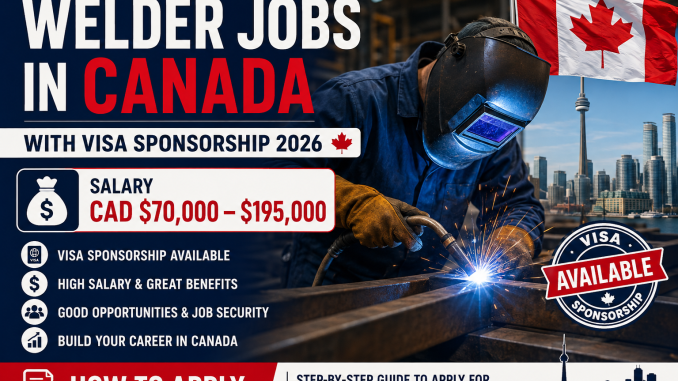
Canada Is Calling Skilled Welders — Are You Ready?
Did you know that Canada faces a shortage of over 100,000 skilled tradespeople — and welders are at the very top of that list? As infrastructure projects, oil sands operations, and manufacturing plants continue to expand across the country, the demand for qualified welders has never been more urgent. And here is the most exciting part: Canadian employers are actively sponsoring international workers to fill these roles.
If you have been searching for welder jobs in Canada with visa sponsorship 2026, this article is your complete roadmap. Whether you are based in Nigeria, Ghana, Kenya, South Africa, or anywhere across Africa and beyond, this guide will walk you through everything — from salary expectations and top employers to the exact steps you need to take to secure a sponsored job offer and relocate legally to Canada.
The opportunity is real. The demand is confirmed. The question is: will you act on it?
Why Canada Is Hiring Welders in 2026
The Labour Shortage Is Real and Well-Documented
Canada’s skilled trades sector is experiencing one of the most severe labour shortages in its modern history. According to the BuildForce Canada report and data from Employment and Social Development Canada (ESDC), the construction and manufacturing industries alone will need to recruit over 300,000 new workers by 2030 to replace retiring baby boomers and meet growing infrastructure demands.
Welders specifically are listed under National Occupational Classification (NOC) code 72106 — a designation that makes them eligible for multiple immigration pathways.
Key Demand Drivers in 2026
- LNG Canada and oil sands expansion in Alberta and British Columbia require thousands of certified pipe and structural welders.
- Trans Mountain pipeline operations and maintenance require continuous skilled welding labour.
- Ontario’s infrastructure boom — including new transit lines, bridges, and industrial facilities — is generating consistent demand.
- Automotive sector reshoring in Windsor and Oshawa is driving demand for MIG and robotic welding specialists.
- Federal housing targets — Canada plans to build 3.87 million new homes by 2031 — are accelerating structural steel and fabrication work.
Government Immigration Support
The Canadian government, through Immigration, Refugees and Citizenship Canada (IRCC), has created dedicated streams to attract skilled tradespeople. Programs like the Federal Skilled Trades Program (FSTP), Provincial Nominee Programs (PNPs), and the Temporary Foreign Worker Program (TFWP) all include welding as an eligible occupation.
RELATED ARTICL|E:
Affordable Apartments in Manchester for New Immigrants: The Complete 2026 Guide
Visa Sponsorship: What It Means for You
Breaking It Down Simply
Visa sponsorship means a Canadian employer agrees to hire you — an international worker — and takes formal legal responsibility for supporting your work permit application. The employer essentially tells the Canadian government: “We need this person. We cannot find a Canadian to do this job. We will hire them from abroad.”
This process typically begins with a Labour Market Impact Assessment (LMIA) — a government evaluation confirming that no qualified Canadian worker is available for the role. Once approved, the LMIA is attached to your job offer letter, which you then use to apply for a Temporary Work Permit or start an Express Entry profile.
Who Qualifies for Visa Sponsorship?
To be considered for a sponsored welder position in Canada, you generally need to meet the following criteria:
- Hold a relevant trade certificate or welding qualification (CWB, CSWIP, AWS, or equivalent)
- Have a minimum of 2 years of hands-on welding experience
- Be in good health and have no serious criminal record
- Meet basic English language requirements (IELTS is not always mandatory but strongly recommended)
- Be willing to relocate to Canada upon approval
What the Employer Covers
The level of support varies by employer, but sponsored packages typically include:
- Work permit application fees (paid by employer)
- Airfare to Canada (for you, sometimes family)
- Temporary accommodation upon arrival (30–90 days)
- Orientation and onboarding support
- Some employers also cover LMIA fees ($1,000 CAD per worker)
[See also: How to Read a Canadian Job Offer Letter – What to Look For]
Average Welder Salary in Canada in 2026
What You Can Realistically Expect to Earn
The salary for welders in Canada in 2026 ranges from CAD $45,000 to $85,000 per year, depending on your experience level, specialisation, and province of employment. Here is a clear breakdown:
| Experience Level | Annual Salary (CAD) | Hourly Rate (Approx.) |
|---|---|---|
| Entry-Level (0–2 years) | $45,000 – $55,000 | $22 – $27/hr |
| Mid-Level (3–6 years) | $55,000 – $70,000 | $27 – $34/hr |
| Senior/Specialist (7+ years) | $70,000 – $85,000+ | $34 – $42/hr |
Province-by-Province Variation
- Alberta: Highest-paying province for welders due to the oil and gas sector — senior welders regularly earn $90,000+ with overtime.
- British Columbia: Average CAD $65,000 – $80,000 for industrial welders.
- Ontario: CAD $55,000 – $75,000, with higher rates in manufacturing hubs.
- Saskatchewan & Manitoba: Growing demand, competitive salaries averaging $58,000 – $72,000.
Benefits Typically Included
Beyond base salary, most sponsored positions come with:
- Pension plan (RRSP contributions or company pension)
- Extended health and dental insurance
- Relocation allowance (CAD $2,000 – $10,000)
- Housing stipend for remote or northern postings
- Paid overtime (time-and-a-half or double time)
- Tool and PPE allowances
Top Employers Currently Sponsoring Welders in Canada
Companies Actively Recruiting International Welders
These are established Canadian companies and multinational firms with a track record of hiring and sponsoring skilled foreign tradespeople:
1. Cloverdale Paint & Industrial Services (Alberta)
A major industrial contractor operating in oil sands and petrochemical facilities. Actively recruits certified pipe welders through LMIA-backed offers.
➡ [Apply at Cloverdale Industrial Services]
2. Aecon Group Inc.
One of Canada’s largest construction and infrastructure companies. Works on pipelines, bridges, and energy projects nationwide. Regularly recruits structural and combination welders.
➡ [Apply at Aecon Group]
3. PCL Construction
A 100% employee-owned construction giant with projects across Canada and internationally. Known for competitive salaries and strong onboarding for foreign hires.
➡ [Apply at PCL Construction]
4. Fluor Canada Ltd.
A global engineering and construction company with major oil sands projects in Fort McMurray, Alberta. Frequently sponsors welders with CSWIP or CWB certification.
➡ [Apply at Fluor Canada]
5. Graham Construction
Operates across energy, infrastructure, and industrial sectors in Western Canada. Offers LMIA-supported positions for MIG, TIG, and stick welders.
➡ [Apply at Graham Construction]
6. Bird Construction Inc.
A national general contractor with projects in mining, oil sands, and commercial construction. Offers relocation packages and benefits for skilled international welders.
➡ [Apply at Bird Construction]
7. Waiward Steel Fabricators (Edmonton, Alberta)
Specialises in structural steel fabrication and erection. One of Alberta’s most active employers of certified welders, including foreign-trained tradespeople.
➡ [Apply at Waiward Steel]
Pro Tip: When applying to these companies, always mention your CWB-equivalent certification and your willingness to obtain Canadian certification upon arrival. This significantly improves your chances.
Requirements & Qualifications
What You Need to Apply
Canadian employers and immigration authorities have specific requirements for sponsored welder roles. Here is a detailed breakdown:
Minimum Education
- High school diploma or equivalent (secondary school certificate)
- A recognised trade school certificate or apprenticeship completion certificate in welding, fabrication, or a related trade is strongly preferred
- CWB (Canadian Welding Bureau) certification is the gold standard — equivalency assessments are available for internationally trained welders
Work Experience
- Minimum 2 years of practical welding experience in an industrial or commercial setting
- Experience with one or more of the following processes is typically required:
- SMAW (Stick Welding)
- GMAW/MIG Welding
- GTAW/TIG Welding
- FCAW (Flux-Cored Arc Welding)
- Pipe welding (a major advantage for Alberta/BC roles)
Language Requirements
- English proficiency is essential. While IELTS is not always mandatory for trade roles, many employers and immigration streams require it.
- Recommended IELTS scores (General Training):
- Listening: 6.0
- Reading: 6.0
- Writing: 5.5
- Speaking: 6.0
- French proficiency is advantageous if applying to Quebec, which has its own immigration stream (Quebec Skilled Worker Program).
Medical and Background Checks
- A medical examination by an IRCC-approved physician
- Police clearance certificate from your country of residence
- Valid international passport (minimum 2 years validity recommended)
Professional Certification
- Foreign welding certifications (AWS D1.1, CSWIP 3.1, ISO 9606) are recognised but may require equivalency testing through the CWB Group upon arrival.
- Some employers will sponsor you before you obtain Canadian certification and allow you to test on arrival.
[See also: How to Get Your Foreign Welding Certification Recognised in Canada]
Step-by-Step: How to Apply for Welder Jobs in Canada with Visa Sponsorship
Your 7-Step Action Plan
Follow these steps carefully and in sequence. Skipping steps is one of the most common reasons applicants fail.
Step 1: Prepare a Canadian-Style CV/Resume
Your resume must follow the Canadian format — typically 1–2 pages, no photo, no date of birth, no marital status. Include:
- A professional summary at the top (3–4 sentences)
- Your welding certifications and codes (e.g., AWS D1.1, CSWIP 3.1)
- Quantifiable achievements: “Completed 2,000+ hours of pipe welding on offshore rigs”
- A skills section listing welding processes, tools, and safety certifications (e.g., WHMIS, First Aid)
Step 2: Get Your Credentials Assessed
If your welding certificates are from outside Canada, consider getting them assessed by:
- CWB Group (for welding-specific certification)
- World Education Services (WES) (for academic credentials)
This step strengthens your application considerably.
Step 3: Search for LMIA-Approved Job Postings
Use the job boards listed in the next section. Filter specifically for jobs that mention:
- “LMIA available”
- “visa sponsorship provided”
- “open to international applicants”
- “TFW (Temporary Foreign Worker) welcome”
Step 4: Submit a Targeted Application
Do not send a generic CV. Tailor your application to each job posting:
- Mirror the language used in the job description
- Address your cover letter to the hiring manager by name if possible
- Include a cover letter that specifically mentions your willingness to relocate and your awareness of the LMIA/work permit process
Step 5: Attend Interviews (Online or In-Person)
Most employers will conduct video interviews via Zoom or Teams for international candidates. Prepare to:
- Demonstrate hands-on welding knowledge
- Discuss specific projects you have worked on
- Show awareness of Canadian safety standards (CSA standards, OH&S regulations)
- Express your commitment to long-term employment in Canada
Step 6: Receive Your Job Offer and Initiate the Visa Process
Once you receive a formal job offer letter, the employer will begin the LMIA application with Employment and Social Development Canada (ESDC). This process takes 2–5 months. Once the LMIA is approved:
- You apply for a Temporary Work Permit via the IRCC portal
- Submit your passport, medical results, police clearance, and LMIA number
- Pay the work permit fee (CAD $155 as of 2025/2026 — confirm current fee at IRCC website)
Step 7: Travel and Relocate to Canada
Upon approval of your work permit:
- Book your flights (some employers reimburse this)
- Arrange temporary accommodation in advance
- Carry all original documents when entering Canada — your job offer letter, work permit approval, passport, and proof of funds
- Report to your employer within the stipulated start date
- Begin your Canadian welding career
Best Job Boards to Find Sponsored Welder Jobs in Canada
Where to Search Right Now
Not all job boards are created equal. These five platforms are the most effective for finding LMIA-supported and visa-sponsored welder jobs in Canada:
1. Job Bank Canada (Government of Canada)
The official government job portal. Employers with LMIA approval often post here first. Filter by “welder” and check “open to foreign nationals.”
2. Indeed Canada
Canada’s largest job aggregator. Search “welder LMIA” or “welder visa sponsorship” for targeted results. Set up daily email alerts.
3. LinkedIn
Essential for networking. Follow companies like Aecon, PCL, and Fluor Canada. Use the “Easy Apply” feature and connect directly with Canadian HR managers and recruiters.
4. Workopolis
A Canada-specific job board popular with trades and industrial employers. Frequently lists positions from Alberta and BC construction firms.
5. Glassdoor Canada
Useful for both job listings and salary research. Read company reviews from current employees to evaluate employers before applying.
Bonus Tip: Search Facebook Groups such as “Canada Jobs for Africans,” “Skilled Workers Canada,” and “Welder Jobs Canada 2026” — many LMIA-approved recruiters post directly in these communities.
Common Mistakes to Avoid
These Errors Cost Applicants Their Chance
Avoid these critical mistakes that derail thousands of international applications every year:
- ❌ Using a non-Canadian CV format — including photos, date of birth, or marital status on your resume will immediately signal that you are unfamiliar with Canadian hiring norms. Remove all personal information beyond your name, contact, and LinkedIn URL.
- ❌ Falling for visa sponsorship scams — legitimate employers do NOT charge you money to process your LMIA or work permit. If someone asks you to pay upfront for a “guaranteed job offer,” it is a scam. Verify every offer through the company’s official website.
- ❌ Applying without relevant certifications — sending a generic CV without mentioning your welding processes, codes, and certifications makes your application invisible. List every certification you hold, even if not Canadian.
- ❌ Ignoring the cover letter — many African applicants skip the cover letter entirely. In Canada, a well-written, tailored cover letter can be the deciding factor between getting an interview and being overlooked. Always include one.
- ❌ Not following up after applying — Canadian hiring processes can take 4–8 weeks. A polite follow-up email one week after applying shows professionalism and genuine interest. Many candidates who follow up get interviews that others miss.
Frequently Asked Questions (FAQ)
Everything You Need to Know
Q1: Can I bring my family to Canada on a work permit?
Yes. Once you have an approved Canadian work permit, your spouse or common-law partner may be eligible for an Open Work Permit, allowing them to work for any employer in Canada. Dependent children can enrol in Canadian schools for free. The exact process depends on your visa category and duration of your work permit.
Q2: Do I need IELTS to apply for welder jobs in Canada?
IELTS is not always mandatory for trade-based jobs, but it significantly strengthens your application. Many Provincial Nominee Programs (PNPs) for skilled trades do require a language test. A minimum score of CLB 4–5 (roughly IELTS 4.5–5.5) is typically acceptable for trade occupations. Check the specific PNP stream requirements for your target province.
Q3: How long does the visa sponsorship process take?
The timeline from job offer to work permit approval typically ranges from 3 to 8 months, broken down as follows:
- LMIA processing: 2–5 months (Global Talent Stream can be faster — 2 weeks)
- Work permit application processing: 4–12 weeks
- Medical and security checks: 2–8 weeks (can run concurrently)
Q4: Is the Federal Skilled Trades Program (FSTP) the right pathway for welders?
Yes. Welders under NOC 72106 are eligible for the Federal Skilled Trades Program, which is an Express Entry pathway. You need:
- A qualifying job offer OR a certificate of qualification from a Canadian province/territory
- At least 2 years of full-time skilled trades work experience
- Meeting language requirements (minimum CLB 4 in speaking/listening, CLB 3 in reading/writing)
Q5: Can I apply for Canadian permanent residency as a welder?
Absolutely. Many welders use the Temporary Work Permit as a pathway to permanent residency (PR). After working in Canada for at least 1 year, you may be eligible for:
- Canadian Experience Class (CEC) under Express Entry
- Provincial Nominee Programs (PNP) — several provinces actively nominate skilled tradespeople for PR
- Rural and Northern Immigration Pilot (RNIP) — if your employer is in a designated community
Canada’s immigration system is designed to transition skilled workers from temporary to permanent status. Welding is a high-demand occupation, which improves your Comprehensive Ranking System (CRS) score in Express Entry draws.
Conclusion: Your Future in Canada Starts With One Application
Canada needs skilled welders — and in 2026, the pathway for international applicants has never been more accessible. With salaries ranging from CAD $45,000 to $85,000, comprehensive benefits packages, genuine relocation support, and a clear route to permanent residency, this is more than just a job opportunity. It is a life-changing move.
If you have the skills, the certifications, and the drive, there is no reason to sit on the sidelines. Start by updating your CV to Canadian standards, research the employers listed in this guide, set up job alerts on the boards above, and take the first concrete step toward your new life.
Welder jobs in Canada with visa sponsorship 2026 are available right now — for people who are prepared, proactive, and persistent.
Do not let fear or uncertainty hold you back. Thousands of Africans and international workers are already building thriving careers in Canada. You can be next.
Bookmark this page and share with someone looking for opportunities abroad.
Leave a Reply